Radon Mitigation in York, PA
Updated
PA DEP has 17,149 home radon tests on record from the ZIP codes that cover York City (17403, 17404, 17401). 51.9% came back at or above the EPA's 4.0 pCi/L action level, against 52.5% for York County as a whole. That is close to the county-wide rate, which is itself about one test in two. A standard system here typically costs $800 to $1,500. The only way to know about one house is to test it.
York City is the oldest and densest housing in the county. Half of its homes were built before 1940, and four in ten are attached rowhomes and twins, many sharing walls down the length of a block. That changes how a radon system gets installed more than it changes whether you need one. The city also has one quirk in the data: downtown ZIP 17401 tests far lower than the rest of the county, while the city's other two ZIP codes test right around the county rate.
What the PA DEP test records show for York City
ZIP codes don't follow city lines, so the 3 ZIP codes below also take in some homes just outside York City.
| ZIP | Tests | Median pCi/L | 4+ pCi/L | 10+ | 20+ |
|---|---|---|---|---|---|
| 17403 | 8,348 | 4.7 | 55.2% | 29.6% | 15.2% |
| 17404 | 8,196 | 4 | 50.7% | 20.2% | 6.1% |
| 17401 | 605 | 1.8 | 22.1% | 3.6% | 0.5% |
| York County | 98,845 | 4.3 | 52.5% | 26.8% | 13.1% |
- ZIP 17403 (about 37% of York City's land): median 4.7 pCi/L across 8,348 tests, 15.2% at 20 or higher, top reading 437. Basement median 5.3, first floor 2.8.
- ZIP 17404 (about 35% of York City's land): median 4 pCi/L across 8,196 tests, 6.1% at 20 or higher, top reading 534. Basement median 4.6, first floor 1.7.
- ZIP 17401 (about 28% of York City's land): median 1.8 pCi/L across 605 tests, 0.5% at 20 or higher, top reading 24. Basement median 3, first floor 1.1.
The spread inside York City runs from 22.1% of tests high in 17401 to 55.2% in 17403.
Half of the story is the median. The other half is the tail: 24.2% of tests here were 10 pCi/L or higher and 10.3% were 20 or higher. The top reading on record in these ZIP codes is 534 pCi/L. Neighboring houses can differ by a factor of ten, so none of this tells you what your house is. It tells you the odds are high enough that a $15 to $30 test kit is worth buying.
Tests people chose to run, not a random survey. Details on the York County radon levels page.
Basement readings versus first-floor readings
In ZIP 17403, basement tests have a median of 5.3 pCi/L, while tests taken on the first floor have a median of 2.8 pCi/L (1,077 first-floor tests). The gap is smaller than in most of the county, which means readings upstairs here are not much of a relief from the basement number.
This matters for what you test. The PA DEP and EPA guidance is to test the lowest level you use or could use as living space. If the basement is finished, or might be someday, test it there. A finished rec room at 5.3 pCi/L is a different decision from an unfinished storage basement you rarely stand in.
Radon results by decade in ZIP 17403
| Decade tested | Tests | Median pCi/L | 4+ pCi/L |
|---|---|---|---|
| 1980s | 100 | 9.6 | 74% |
| 1990s | 1,427 | 5.3 | 59.8% |
| 2000s | 2,084 | 5.3 | 58.7% |
| 2010s | 3,304 | 4.6 | 54.1% |
| 2020s | 1,433 | 3.5 | 46.5% |
The share peaked in the 1980s at 74% and sits at 46.5% for tests since 2020. A drop that size is mostly about who is testing, not the ground. More recent tests come from home sales and from retests after a system went in, and both pull the share down. The rock under York City has not changed. 1,433 tests have been logged in 17403 since 2020, so people here are still testing.
The ground under York City
York City sits in the York Valley, the band of limestone and dolomite that runs east to west through the middle of the county (PA DCNR's Piedmont Lowland section). Carbonate rock carries radium, and it dissolves along cracks over time, which opens pathways for soil gas to reach a foundation.
The low numbers in downtown ZIP 17401 (a median of 1.8 pCi/L across 605 tests) are more likely about the buildings than the rock. Downtown tests skew toward upper floors and apartments, and first-floor tests there have a median of just 1.1 pCi/L. If you live in a rowhome with a basement anywhere in the city, go by your own test, not by the downtown average.
Housing in York City and what it means for a system
Census Bureau, American Community Survey 2020 to 2024:
| York City | York County | |
|---|---|---|
| Homes (housing units) | 19,505 | 189,857 |
| Median year built | 1941 | 1976 |
| Built before 1940 | 49.3% | 18.3% |
| Built before 1980 | 85.7% | 54.8% |
| Built 2000 or later | 4.1% | 20.6% |
| Single-family detached | 22.1% | 64.3% |
| Attached (rowhome, townhouse) | 40.2% | 17.1% |
| Mobile homes | 0.4% | 4.1% |
| Owner-occupied | 43.7% | 76.3% |
49.3% of the homes in York City were built before 1940, against 18.3% county-wide. Houses that old usually sit on stone or early block foundations with no vapor barrier and plenty of joints, which gives soil gas more ways in. They are still very fixable. The installer just spends more time sealing, and sometimes needs a second suction point, which is why these jobs tend to land toward the upper end of the cost range.
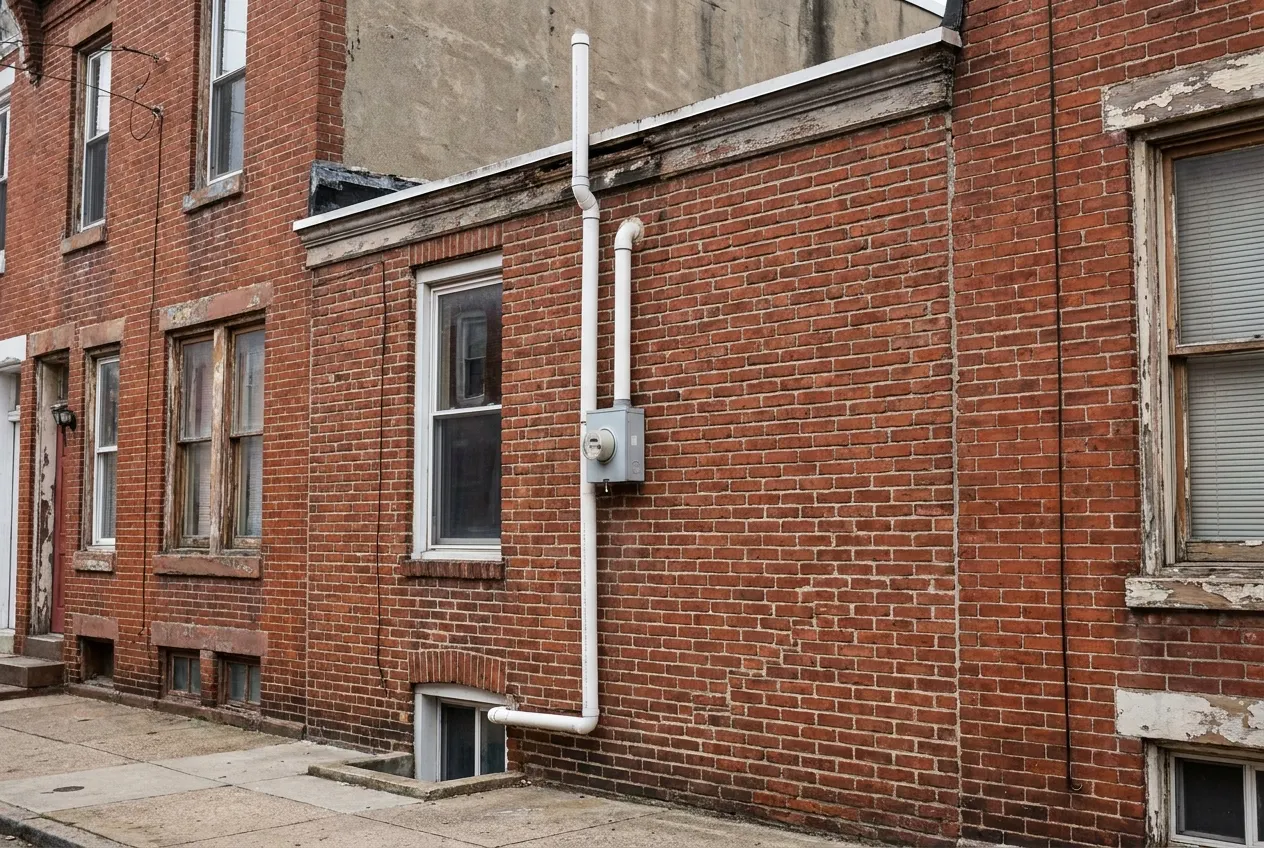
About 40.2% of homes here are attached: rowhomes, twins and townhouses. A shared wall does not stop radon, and neither does a neighbor's system, so each unit needs its own test. The tricky part is pipe routing, since there is often no side yard to run the vent up. Our rowhome radon guide covers how installers handle it.
Only about 43.7% of homes in York City are owner-occupied, so a lot of people here rent. Pennsylvania does not require landlords to test, but a tenant can ask, and a landlord can test between tenancies without much hassle. Our landlord testing guide covers the details.
Cost-wise, an attached home in York City is usually still a single suction point, so $800 to $1,500 is the normal range, but a long interior pipe run to get above the roof line can push it higher. Full ranges on the cost page.
Where we work in York City
That covers the downtown blocks around Continental Square and the Central Market district. U.S. 30 and Interstate 83 carry most traffic around and through the city. Public schools here are part of the York City School District. The Continental Congress met here in 1777 and 1778, which is where the Articles of Confederation were adopted.
Installers must hold a PA DEP radon mitigation certification (how to check), and permit questions go to the city office at yorkcity.org.
Common questions
Is radon a problem in York City?
Yes. PA DEP has 17,149 tests on record from the ZIP codes covering York City, and 51.9% of them came back at or above the EPA's 4.0 pCi/L action level. 10.3% were at 20 pCi/L or more. The county-wide rate is 52.5%.
What is the average radon level in ZIP 17403?
The median of 8,348 PA DEP tests in ZIP 17403 is 4.7 pCi/L and the mean is 11.4 pCi/L. A mean that far above the median means a long tail of very high readings, topping out at 437 pCi/L.
Does a York City rowhome need its own radon test if the neighbor has a system?
Yes. A system in the house next door lowers the pressure under that house's slab, not yours. Shared walls do not share a foundation seal, so each unit needs its own test and, if it is high, its own suction point.
Nearby
Spring Garden Township 55.2%, Springettsbury Township 54.1%, West Manchester Township 50.5%, Manchester Township 51.3%, York Township 57%. Share of PA DEP tests at or above 4.0 pCi/L, against 51.9% here.
Have a test result from York City?
Send us the number and the foundation type, or call and read it out.
Request a Free Quote Call (717) 356-9995