Radon Mitigation Cost in York, PA
Updated
A standard radon mitigation system in York County typically costs $800 to $1,500, with larger homes, extra suction points or a more complex foundation pushing the total toward $2,500. Crawlspace membrane systems usually run higher, often $1,500 to $3,000 or more. Foundation type drives the price, not how high the number came back. A real price needs a site visit, not a phone estimate.
Get a free estimate for your property
Tell us your test result and what kind of foundation the house has. We'll follow up with next steps and a written number for your home. No obligation.
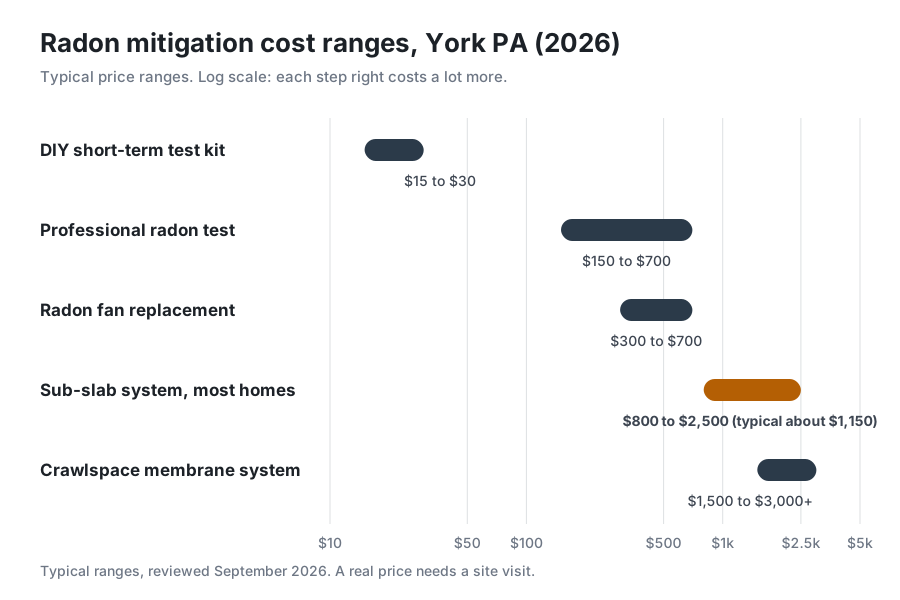
Cost by system type
Every radon mitigation system does the same basic job, pulling soil gas from beneath the house and venting it safely above the roofline, but the method, materials and labor involved change a lot depending on what kind of foundation is under the house. The table below covers the system types used across York County, with typical low, typical and high figures for each.
| System type | Low | Typical | High |
|---|---|---|---|
| Active sub-slab depressurization | $800 | $1,150 | $2,500 |
| Drain-tile suction | $700 | $1,000 | $1,800 |
| Sump-pit suction | $650 | $950 | $1,700 |
| Crawlspace membrane / sub-membrane suction | $1,500 | $2,200 | $3,000+ |
| Block-wall suction | $900 | $1,300 | $2,200 |
| Radon-resistant new construction (fan added to existing rough-in) | $350 | $500 | $1,200 |
These are typical ranges, not quotes. Standard sub-slab and crawlspace figures line up with the national ranges cited by Angi and HomeGuide's 2026 cost data; the rest reflect how those methods compare in materials and labor. An actual price depends on your specific foundation. See radon mitigation system types for how a contractor decides which one your house needs.
Why some systems cost less than others
The price spread above isn't random. A drain tile loop or a sump pit that already connects to the soil beneath the slab is, in effect, a suction field that's already installed. Converting one into a mitigation system mostly means sealing it properly, capping it, and adding a fan and a manometer, which is why those options usually come in under a full sub-slab depressurization build from scratch.
Crawlspace work costs more for the opposite reason. There's no slab to seal, so the contractor has to build one out of heavy polyethylene sheeting, sealed to the foundation walls and piers around the entire perimeter, which is more material and more labor in a cramped, awkward space. Full detail on crawlspace radon and sub-membrane systems.
Block-wall suction sits in the middle because it's usually added on top of a slab system rather than instead of one, to address radon traveling up through the hollow cores of a block foundation wall. New construction is the cheapest scenario of all when the builder already installed a passive vent pipe and sealed membrane; activating it with a fan is far less work than starting from an unmitigated foundation. See passive vs. active systems and radon in new construction.
Cost by house type
York County's housing stock varies block by block, and the foundation under a house matters more than its age, size or neighborhood. Here's roughly how common local house types compare.
| House type | What's different | Typical range |
|---|---|---|
| York row homes | Shared party walls, often stone or early block foundations; usually one suction point unless the slab is divided | $800 to $1,500 |
| Split-levels | Multiple slab levels or a partial basement can need one or two suction points | $900 to $1,800 |
| Older stone-foundation homes | Rubble or stone foundations are harder to core and seal; may need block-wall suction added | $1,000 to $2,200 |
| Homes with crawlspaces | Membrane system covering the full dirt floor, sealed to the foundation | $1,500 to $3,000+ |
| Slab-on-grade | No basement to run pipe through, so the route typically goes through a closet, garage or exterior wall | $900 to $1,800 |
Row homes in the City of York and older boroughs frequently mix construction types under one roofline, which is covered in more detail on radon in row homes and attached houses. See also York County radon levels for the geology behind why the county tests high broadly, and the service area page for a look at housing stock across York County.
What drives the price
Two houses with the same test result can get quotes several hundred dollars apart, and it's almost never about the reading. Here's what actually moves the number.
Foundation type
A simple poured basement slab is the cheapest foundation to mitigate. A crawlspace, a stone foundation, a mix of foundation types under one roofline, or a slab with no accessible sub-area all add cost because each one changes the method, not just the labor time.
Number of suction points
This is usually the single biggest driver. Each suction point is a cored hole through the slab, an excavated pit beneath it, and additional pipe. A slab poured on clay or compacted fill, rather than clean gravel, often can't be depressurized from one point, and a mixed foundation frequently needs a separate point for each section.
Interior vs. exterior pipe routing
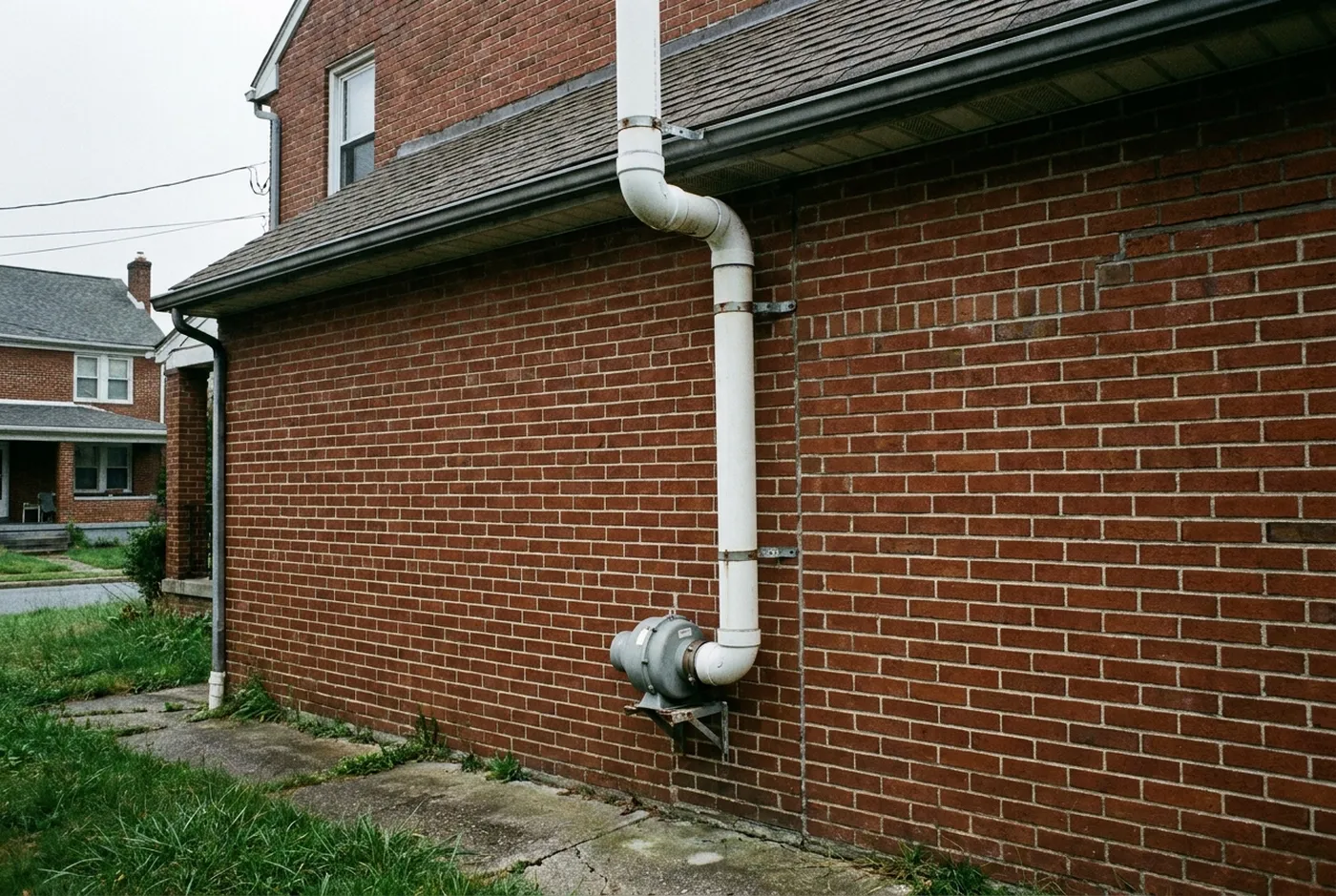
An interior run through a closet or utility space is more labor and more disruption to finished space, but stays out of sight. An exterior run down the outside wall is faster to install but is visible from the street, and in cold weather condensate inside the pipe can occasionally freeze.
Attic vs. exterior fan placement
Where the fan mounts changes both the labor and the noise profile. An exterior-mounted fan is straightforward to access for maintenance; an attic-mounted fan keeps it out of the weather but adds labor to reach and can transmit more sound into living space below if it isn't isolated properly.
Sealing
Sealing accessible slab openings, the sump lid, and the perimeter joint is part of a complete job. A foundation with more cracks, more penetrations, or a poorly sealed sump adds time, though sealing alone is never a substitute for the pipe-and-fan system. See does sealing cracks reduce radon for why sealing supports a system rather than replacing one.
Electrical work
The fan needs a dedicated, accessible electrical connection with a disconnect switch. Whether that's a straightforward tie-in near an existing circuit or a longer run to reach the fan's location affects the final price.
Running costs after the install
A radon fan runs continuously, day and night, year-round, and draws about as much power as a household light bulb left on. Most homeowners see roughly $5 to $10 a month in added electricity, or somewhere around $50 to $150 a year. The system also carries some soil-gas conditioned air out with it, which has a modest heating and cooling cost; good sealing at the suction point keeps that small.
The real recurring expense is the fan itself. It's a wear item, typically good for five to ten years before it needs replacing, and a replacement usually runs a few hundred dollars, in the neighborhood of $300 to $700 depending on the model and whether the swap is straightforward. PA DEP also recommends retesting roughly every two years regardless of how the system seems to be performing, which costs about the same as an initial short-term kit. Full detail on radon fans, manometers and system maintenance, including how to read the U-tube manometer that tells you the fan is still working.
Testing costs, before and after
Testing is cheap relative to the stakes and happens twice: once to confirm there's a problem, and once to confirm the fix worked. A DIY charcoal-canister short-term kit runs about $15 to $30 and is a legitimate, EPA-recognized way to get a first number in two to seven days under closed-house conditions. A professional test, usually run with continuous radon monitoring equipment, costs more, typically $150 to $700, and is the standard for real estate transactions because it produces real-time data instead of a single averaged reading. Compare methods on short-term vs. long-term radon tests and see how to test your home for radon for the full walkthrough.
After the system is running for at least 24 hours, a post-mitigation test confirms the level actually dropped below the EPA's 4.0 pCi/L action level. This isn't optional in any meaningful sense: it's the step that verifies the job worked rather than just assuming it did, and it's the documentation a buyer's agent will ask for years down the line.
Radon and real estate transactions in York
Pennsylvania doesn't require radon testing before a home sale, but under the state's Real Estate Seller Disclosure Law a seller must disclose a radon test result they already have. In practice, buyers routinely request a test during the 10 to 15 day inspection contingency window after an accepted offer, and if the result comes back at or above 4 pCi/L, it's common for mitigation to become a condition of closing, or for the buyer to negotiate a credit toward having it installed afterward.
Who actually pays for it isn't fixed by law, it's negotiated deal by deal, sometimes as a repair completed before closing and sometimes as a closing credit. On a real estate timeline, mitigation compresses to roughly two weeks: a short-term confirmation test, a site visit, the install itself (usually one day), and a post-mitigation retest. This is general information, not legal advice, and a real estate agent or attorney should be the final word on any specific contract. Full detail on radon testing when buying or selling a home.
DIY vs. professional, and why PA requires certification
Pennsylvania is one of the few states that legally requires certification for this work. Under the state's Radon Certification Act, anyone performing radon testing or mitigation for compensation must hold an active PA DEP certification, with one narrow exception: fixing radon in a home you personally own and occupy. A landlord mitigating a rental, even one they own, falls outside that exemption.
A DIY test is a reasonable, inexpensive first step, and a $15 to $30 kit gives a valid result under closed-house conditions. A DIY mitigation system is a different matter. Beyond the legal line, the most common DIY mistake is guessing the suction point instead of running diagnostic communication testing first, which is how a system ends up covering only part of a slab. A homemade system also has no certified post-mitigation test behind it, which tends to surface as a negotiating problem rather than a resolved item when the home is sold. See can I install a radon system myself in Pennsylvania for the full breakdown.
How to read a quote
Compare quotes on what's actually included, not just the bottom line. A cheaper number frequently means one of these has been left out:
- Diagnostic communication testing before the suction point is chosen, not a guess from a floor plan
- All materials: pipe, fittings, fan, manometer, electrical work, sealant
- Electrical work to power the fan, including a disconnect that can actually be reached
- Sealing of accessible slab openings, the sump lid, and the perimeter joint
- A post-mitigation test, with a stated remedy if the result doesn't land below the action level
- Permit fees where the borough or township requires one, and a clear answer on who pulls it
- A written system description label, which the standards require on the finished install
- A specific, guaranteed number in writing, not just an assurance that levels will come down
A written scope that answers those points before anything is cut is worth more than a lower price that doesn't. See how to choose a radon mitigation contractor for the full list of questions to ask and how to verify a certification number in DEP's public database.
Red flags
- No PA DEP certification number offered, or reluctance when you ask to verify it
- A quote given over the phone or from a floor plan, without anyone looking at the foundation
- No post-mitigation test included, or it's billed as a costly extra
- Pressure to sign the same day, or a price that "expires" quickly
- A price that changes with your test result rather than with your foundation
- Planning to mount the fan inside living space, which is a safety failure, not a design choice
Ways to lower the cost without cutting corners
- Ask whether an existing drain tile loop, sump pit, or passive rough-in can be used instead of building a new suction field from scratch
- Get the diagnostic communication test done before the quote, so the number of suction points is based on data instead of a worst-case guess
- Bundle sealing work into the same visit rather than as a separate trip
- Ask about permit costs up front if your borough or township requires one, so it isn't a surprise line item
- Keep the post-mitigation test in the original scope instead of paying for it separately later
What isn't a legitimate way to lower the cost: skipping the post-mitigation test, using an uncertified installer, or choosing a system based on the lowest quote without checking what it leaves out. See what happens if you ignore a high radon result for what an unaddressed result actually risks.
How long the install takes
For a standard sub-slab system in a single-family home, installation is usually a single day, roughly four to eight hours depending on foundation complexity. Crawlspace membranes, multiple suction points, and mixed foundations can push that to two days. Before the post-mitigation test can start, the system needs to run for at least 24 hours so the house reaches its new steady state, and the test itself then runs two to seven days depending on the device. Full timeline detail, including how it compresses around a real estate closing date, is on how long does radon mitigation take and our process page.
Permits and local requirements
Whether a permit is required depends on the borough or township, not the county as a whole, and practice varies across York County's many small municipalities. A quote should state the permit position plainly and say who's responsible for pulling it. What doesn't vary anywhere in Pennsylvania is certification: the installer must hold an active PA DEP certification under the Radon Certification Act, regardless of local permit rules.
Serving York and York County
This pricing applies across York, West York, Manchester, Dover, Red Lion, Shrewsbury and the rest of York County, since foundation type, not zip code, is what actually sets the number. Every county bordering York, including Adams, Cumberland, Dauphin and Lancaster, is also mapped by the EPA in Radon Zone 1, so the same pricing logic generally applies just outside the county line too. See the full service area for coverage detail by town.
Frequently asked questions
How much does radon mitigation cost in York, PA?
Most single-family homes in York County get a standard sub-slab depressurization system installed for $800 to $1,500. Larger homes, multiple suction points, or a more complex foundation can push the total toward $2,500 or higher. Crawlspace membrane systems typically cost more, often $1,500 to $3,000 or more. Foundation type, not the radon reading, is what actually sets the price.
What is the cheapest radon mitigation option?
Activating an existing passive rough-in, an existing interior drain tile loop, or a usable sump pit is usually the cheapest option, because the suction field is already installed underground. In those cases a contractor may only need to add a fan, seal the access point, and fit a manometer.
Does the price depend on how high my radon level is?
No. Foundation type and the number of suction points a house needs drive the price, not the pCi/L reading. A house that tested at 30 pCi/L and a house that tested at 5 pCi/L, with the same foundation, usually get the same system at the same price.
Is radon testing included in the mitigation price?
Usually not. A professional radon test typically runs $150 to $700 and is billed separately from the mitigation work, though a contractor will often use a test you already have rather than charging for a new one. A DIY short-term kit costs about $15 to $30.
Who pays for radon mitigation when selling a home in York, PA?
There is no fixed rule. It is typically negotiated between buyer and seller during the home inspection contingency period, sometimes as a repair completed before closing and sometimes as a credit at closing. This is general information, not legal advice; a real estate agent or attorney can speak to a specific contract.
Can I install a radon mitigation system myself to save money?
Only legally in a home you personally own and occupy, under the exemption in Pennsylvania's Radon Certification Act. Installing for anyone else, including a rental you own but do not live in, requires PA DEP certification. A DIY system also has no certified post-mitigation test behind it, which tends to become a problem at resale.
How much does it cost to run a radon fan?
Roughly $5 to $10 a month in most homes, comparable to a light bulb left running continuously, or about $50 to $150 a year. The fan itself typically lasts five to ten years before it needs replacing, which usually costs a few hundred dollars.
Do older York homes with stone foundations cost more to mitigate?
Often yes. Stone and rubble foundations are harder to core and seal cleanly than a poured slab, and may need a block-wall suction approach layered alongside a slab system, which adds material and labor.
Will a cheap radon mitigation quote actually work?
Sometimes, but the same red flags apply here as any trade: no written scope, no post-mitigation test included, or a price given without anyone looking at the foundation. A guaranteed number with a defined remedy is worth more than a low bottom line.
How soon can I get an exact price instead of a range?
After a site visit. Foundation type is the single biggest driver of cost and cannot be priced accurately over the phone or from a floor plan alone.
Want a real number for your property?
Tell us your foundation type and test result if you have one. We'll follow up with next steps.
Request a Free Quote